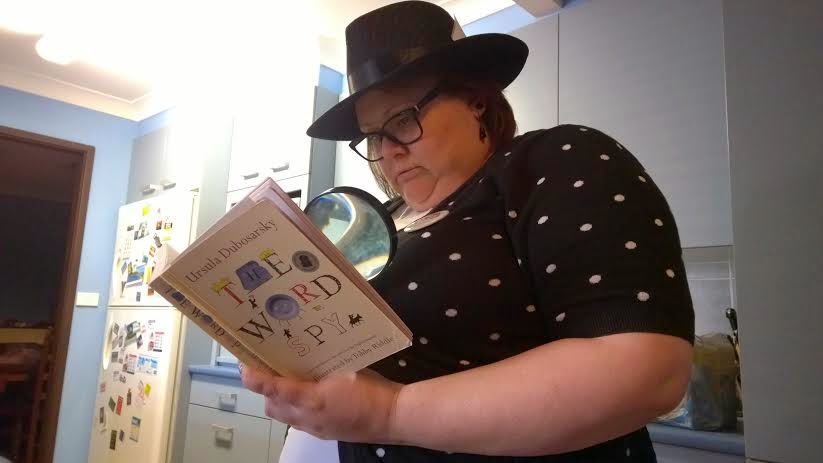
Some words are just TOO mysterious, even for Word Spies!
http://mentalfloss.com/article/71161/15-basic-words-are-etymological-mysteries
Ah, you've found my blog! Great - now we can really get talking...about WORDS. There might be something WORDY you've always wondered about. Or you might even have a WORDISH secret you'd like to share. So go on - post a comment or email ursuladubos@gmail.com and I will get back to you on this page as soon as I can. Yours in word and deed, The WORD SPY
Saturday, January 30, 2016
Friday, November 20, 2015
Trés curieux! from La Word Spy
Dear Spies and Snoops,
I wonder if any of you can speak French? Because the Word Spy found this very puzzling rebus puzzle in the window of a hairdresser in Paris, offering 20 per cent off the next hair cut to anyone who can work out what it means!
A rebus puzzle is one that uses pictures to show the sounds of words. To work this puzzle out you will have to know French pretty well. To start you off, have a look at the first picture. It is of a glass of milk. Now in French, the word for milk is "lait" which is pronounced "lay". Another word in French which is pronounced "lay" is "les" which is the word for "the". Hmm, so I think the first word of this puzzle is PROBABLY "les".
But then again - maybe not. Look at the next picture. It is a person with a question mark. So probably the French word for "who" - "qui" pronounced "kee". It is followed as you see by the letter "p". So perhaps it is "l'équipe", which is French for "the team" pronounced "laykeep"...
Phew - this is exhausting - and only one word! I wonder, can you help me?
Ton amie, la Word Spy
Mysteriously unknown words from the Word Spy
Dear Spies and Snoops,
We all love finding out where words come from - well I know I do!
But in fact, there are some words that NOBODY knows where they come from... How very STRANGE.
Some of them are very common words too - have a look at this fascinating link.
http://mentalfloss.com/article/71161/15-basic-words-are-etymological-mysteries
Dog, bad, big, girl, boy, donkey, bird, surf, fuss, blight, log, tantrum, toad, curse, kick - nobody knows where these words came from!
Hmm - I know. Why don't you spies and snoops out there write me a story using all these mysterious ones - in one VERY mysterious adventure?
I can't wait to read what you come up with...
yours, unknown, The Word Spy (aka the Word Snoop)
We all love finding out where words come from - well I know I do!
But in fact, there are some words that NOBODY knows where they come from... How very STRANGE.
Some of them are very common words too - have a look at this fascinating link.
http://mentalfloss.com/article/71161/15-basic-words-are-etymological-mysteries
Dog, bad, big, girl, boy, donkey, bird, surf, fuss, blight, log, tantrum, toad, curse, kick - nobody knows where these words came from!
Hmm - I know. Why don't you spies and snoops out there write me a story using all these mysterious ones - in one VERY mysterious adventure?
I can't wait to read what you come up with...
yours, unknown, The Word Spy (aka the Word Snoop)
Thursday, October 29, 2015
La réponse?
Chers espions et fouiners.....
Here is the answer to yesterday's (or was it the day before?) seventeenth century French code.
In French it means:
JE SENS QUE JE NE CESSERAI JAMAIS DE T'AIMER
Aha!
(what's that in English?? I'll tell you tomorrow)
A bientôt!
L'espion des mots.....
Here is the answer to yesterday's (or was it the day before?) seventeenth century French code.
In French it means:
JE SENS QUE JE NE CESSERAI JAMAIS DE T'AIMER
Aha!
(what's that in English?? I'll tell you tomorrow)
A bientôt!
L'espion des mots.....
Sunday, October 25, 2015
CENTURIES OLD SECRET CODE!!!!
Dear Spies and Snoops,
Well this is a real challenge! Look what the Word Spy found yesterday in the National Archives in Paris.
A love letter in code from 1783 - from an unknown young woman to her cousin Pierre (who sadly died in a duel a few years later).
She wrote in code to keep her love a secret. If you look closely, you will see some of the letter are replaced with numbers.
Have a close look at the last two lines.
32 S28S Q52 32 C2SS2R13 316113S D2 T1362R
Hem, one problem. She wrote in FRENCH. So you will need to know French to work out the code.
Hint - the word "JE" means "I". In the letter, "JE" is "32"
I'll tell you the answer tomorrow!
yours 2085 2315184 191625 .....
Friday, October 9, 2015
What is the answer? from Anthony
Hi Word Spy,
I am reading your first book. It is the best non fiction book I have ever read! I am stuck on the rebus code and even the hint page won't help me. I am just really confused.:D
from Anthony
Dear Anthony,
How happy I am to hear how much you have enjoyed the first Word Spy Book! -:)
How sad I am to hear that you are stuck on the rebus code... -:(
Let's see if I can help.
If you look at the letters U R A
and say them out loud, it sounds like "YOU ARE A"
so that's the first bit done.
Then have a look at the list of the words written under that. There is a little arrow pointing to the word SECRET at the TOP of the list.
Aha! I bet you've got it now.
from your friend, the (top secret) Word Spy....
I am reading your first book. It is the best non fiction book I have ever read! I am stuck on the rebus code and even the hint page won't help me. I am just really confused.:D
from Anthony
Dear Anthony,
How happy I am to hear how much you have enjoyed the first Word Spy Book! -:)
How sad I am to hear that you are stuck on the rebus code... -:(
Let's see if I can help.
If you look at the letters U R A
and say them out loud, it sounds like "YOU ARE A"
so that's the first bit done.
Then have a look at the list of the words written under that. There is a little arrow pointing to the word SECRET at the TOP of the list.
Aha! I bet you've got it now.
from your friend, the (top secret) Word Spy....
Monday, October 5, 2015
Can you make a kenning? from the Word Spy
Dear Word Spies,
I wonder if you have ever thought of making up a kenning.
A kenning????
What's that???
Read on, my spies. I look forward to hearing about some of your own wordy inventions!
http://www.bl.uk/learning/langlit/changlang/activities/lang/anglosaxon/anglosax.html
from the Syllable-Peeker,
aka THE WORD SPY
Hi Word Snoop, it's me, Betty Autumn.
Here is my Kenning, its called a Honey Bike. I have this sweet little wooden bike my sweet little brother rides on. When I was 8, I called it a Honey Bike and the name stuck. He is two and a half and he still rides and calls it the Honey Bike
Betty Autumn
Dear Betty,
Looks like you are a natural! Wonderful work (as always)
your mellifluous pal,
The Word Snoop
I wonder if you have ever thought of making up a kenning.
A kenning????
What's that???
Read on, my spies. I look forward to hearing about some of your own wordy inventions!
http://www.bl.uk/learning/langlit/changlang/activities/lang/anglosaxon/anglosax.html
from the Syllable-Peeker,
aka THE WORD SPY
Hi Word Snoop, it's me, Betty Autumn.
Here is my Kenning, its called a Honey Bike. I have this sweet little wooden bike my sweet little brother rides on. When I was 8, I called it a Honey Bike and the name stuck. He is two and a half and he still rides and calls it the Honey Bike
Your Fellow Word Snoop,
Betty Autumn
Dear Betty,
Looks like you are a natural! Wonderful work (as always)
your mellifluous pal,
The Word Snoop
Friday, September 11, 2015
What does it mean??? wonders the Word Spy
The Word Spy is travelling in Paris at the moment and spotted this in a tapestry at the Cluny museum of the Middle Ages - hmm - what is this strange writing, I wonder? It is over 500 years old. If you have any ideas, be sure to let the Word Spy know!
Dear Word Snoop,
Hello, it's me, Betty Autumn from Vermont.
I think that tapestry shows two monks reading a book about Marco Polo's travels along the silk road and him going all the way to China and back. The numbers are Italian and show how many robbers he fought off.
Your fellow snoop (or spy),
Betty Autumn
WONDERFUL!
yours (in wonder) The Word Snoop (or spy)
Dear Word Snoop,
Hello, it's me, Betty Autumn from Vermont.
I think that tapestry shows two monks reading a book about Marco Polo's travels along the silk road and him going all the way to China and back. The numbers are Italian and show how many robbers he fought off.
Your fellow snoop (or spy),
Betty Autumn
WONDERFUL!
yours (in wonder) The Word Snoop (or spy)
Monday, August 24, 2015
Abstract or concrete? from Izzy
Dear Word Spy,
I need clarification on abstract and concrete nouns. Such as, is sportsmanship or good an abstract noun? and would neighbors be a concrete noun? Please let me know, thanks.
Izzy
Dear Izzy,
Well, usually concrete nouns are described as things you can touch (it comes from a Latin word meaning hard and solidified) and abstract nouns are things you think about, ideas.
So sportsmanship and good would be abstract nouns, as they are ideas. And I guess if your neighbour is solid to touch you could say a neighbour is a concrete noun! although most often people when speaking of concrete nouns mean objects (like shoes or books) rather than living things.
In the phrase, "love for your neighbour", love is definitely an abstract noun, because it's a feeling or an idea. Love isn't something you can hold in your hand.
I hope this helps! Neither of the categories is so strict that there won't be nouns that fit both categories, or indeed nouns that are neither perhaps abstract or concrete ...
yours, in abstraction, The Word Spy
I need clarification on abstract and concrete nouns. Such as, is sportsmanship or good an abstract noun? and would neighbors be a concrete noun? Please let me know, thanks.
Izzy
Dear Izzy,
Well, usually concrete nouns are described as things you can touch (it comes from a Latin word meaning hard and solidified) and abstract nouns are things you think about, ideas.
So sportsmanship and good would be abstract nouns, as they are ideas. And I guess if your neighbour is solid to touch you could say a neighbour is a concrete noun! although most often people when speaking of concrete nouns mean objects (like shoes or books) rather than living things.
In the phrase, "love for your neighbour", love is definitely an abstract noun, because it's a feeling or an idea. Love isn't something you can hold in your hand.
I hope this helps! Neither of the categories is so strict that there won't be nouns that fit both categories, or indeed nouns that are neither perhaps abstract or concrete ...
yours, in abstraction, The Word Spy
Monday, July 13, 2015
Four, fourth, fourteen, FORTY?? via Sue- Anne
Dear Word Spy,
I'm hoping very much that you can help a friend of mine who has asked this question ...
"If we have FOUR and FOURTEEN...then why do we have FORTY and not FOURTY? This really bugs me! Is there a logical explanation ... ? 😣"
Yours forever in awe of your knowledge and cleverness smile emoticon Sue-Anne
Dear Sue-Anne,
Firstly ALL APOLOGIES for the delay in answering this delightful question - for some reason I just didn't see it on the page until tonight. (not VERY good word spying there!) Please apologise to your friend for me. Dear dear.
Now, as for an answer... Hmm. Well, let's see. The word FORTY comes from Old English FEOWERTIG meaning ten groups (tig) of four (feower). And FOURTEEN comes from Old English FEOWERTENE meaning ten more than (tene) four (feower.)
Not much help there! At that rate we should be spelling them FEOWER, FEOWERTENE and FEORWTIG. But as times passes, spelling mysteriously changes, and perhaps not always with a great deal of logic around it.
Tell you what, I am going to approach my consultant Word Spy, P.A.W. for some in-depth insight into this problem, and I will let you know as soon as I hear back from her.
warm wordy wondering wishes, The Word Spy
PS UPDATE Further to this, having consulted P.A.W. here is a marvellous, almost TOO rich, link with FEOWER (Old English four) related words which is a dizzying pleasure to read. I especially like the word Feorthling, meaning "a fourth part"which of course turned in to "farthing". For your recommended delectation! http://www.digilibraries.com/html_ebooks/100259/31543/www.digilibraries.com@3@1@5@4@31543@31543-h@files@dict_dg-8.html#word_feqortha
THANK YOU PENNY! (the Word Spy's much smarter colleague...)
I'm hoping very much that you can help a friend of mine who has asked this question ...
"If we have FOUR and FOURTEEN...then why do we have FORTY and not FOURTY? This really bugs me! Is there a logical explanation ... ? 😣"
Yours forever in awe of your knowledge and cleverness smile emoticon Sue-Anne
Dear Sue-Anne,
Firstly ALL APOLOGIES for the delay in answering this delightful question - for some reason I just didn't see it on the page until tonight. (not VERY good word spying there!) Please apologise to your friend for me. Dear dear.
Now, as for an answer... Hmm. Well, let's see. The word FORTY comes from Old English FEOWERTIG meaning ten groups (tig) of four (feower). And FOURTEEN comes from Old English FEOWERTENE meaning ten more than (tene) four (feower.)
Not much help there! At that rate we should be spelling them FEOWER, FEOWERTENE and FEORWTIG. But as times passes, spelling mysteriously changes, and perhaps not always with a great deal of logic around it.
Tell you what, I am going to approach my consultant Word Spy, P.A.W. for some in-depth insight into this problem, and I will let you know as soon as I hear back from her.
warm wordy wondering wishes, The Word Spy
PS UPDATE Further to this, having consulted P.A.W. here is a marvellous, almost TOO rich, link with FEOWER (Old English four) related words which is a dizzying pleasure to read. I especially like the word Feorthling, meaning "a fourth part"which of course turned in to "farthing". For your recommended delectation! http://www.digilibraries.com/html_ebooks/100259/31543/www.digilibraries.com@3@1@5@4@31543@31543-h@files@dict_dg-8.html#word_feqortha
THANK YOU PENNY! (the Word Spy's much smarter colleague...)
Wednesday, May 20, 2015
I cannot understand it! from Betty
Dear Word Snoop,
Hi, it's me, Betty Autumn from Vermont, USA.
We are studying contractions in Grammar class ... if "let's" = "let us" and "didn't" = "did not" why does "can't" = "cannot (one word)? and not "can not" (two words like all the rest)?
My mom and I wonder who decided to smoosh them together?
Betty
Dear Betty,
Always great to hear from you!
You know, this is something I used to wonder about myself at school. I remember complaining about it to MY mother.
But the answer is - the great UNKNOWN.
Contractions have been used in English for hundreds and hundreds of years, and, as you say, they mostly make sense. Hmm, but when it comes to "cannot", nobody seems to know why the two words are glued together like that. It may simply be because the "n" at the end of "can" had a natural tendency to stick itself to the "n" at the beginning of "not". So perhaps it's one of those things that just happened and we all got used to it!
Still, I like a good mystery....
Thanks for writing!
yours, cannily,
The Word Spy
Hi, it's me, Betty Autumn from Vermont, USA.
We are studying contractions in Grammar class ... if "let's" = "let us" and "didn't" = "did not" why does "can't" = "cannot (one word)? and not "can not" (two words like all the rest)?
My mom and I wonder who decided to smoosh them together?
Betty
Dear Betty,
Always great to hear from you!
You know, this is something I used to wonder about myself at school. I remember complaining about it to MY mother.
But the answer is - the great UNKNOWN.
Contractions have been used in English for hundreds and hundreds of years, and, as you say, they mostly make sense. Hmm, but when it comes to "cannot", nobody seems to know why the two words are glued together like that. It may simply be because the "n" at the end of "can" had a natural tendency to stick itself to the "n" at the beginning of "not". So perhaps it's one of those things that just happened and we all got used to it!
Still, I like a good mystery....
Thanks for writing!
yours, cannily,
The Word Spy
Sunday, April 19, 2015
Acrostic adventures in New York
Dear Spies,
The Word Spy (aka The Word Snoop) is excited to see that one of her pangrammatic inventions features in the (very hard!) acrostic puzzle in the New York Times last weekend - click here and have a look!
What the puzzle uses is something the Word Spy wrote in the first Word Spy book:
A black cat dreamt every fourth goose hunted invisible jellyfish. Kindly let many nice ostriches pass quickly. Rather stupidly the umbrella voted when x-raying yellow zebras.
Okay, spies, you tell me. What's special about this paragraph?
Hint: Look at the first letter of each word!!!
yours, alphabetically,
The Word Spy
Wednesday, March 11, 2015
Dear Word Spies,
Here's a way at looking at the history and the spread of English - through maps, charts and graphs (and words of course!). This is the link, but over the next few weeks we might have a look at some of them one by one.
http://www.vox.com/2015/3/3/8053521/25-maps-that-explain-english
Till soon, my spies,
Yours, graphically,
THE WORD SPY
Here's a way at looking at the history and the spread of English - through maps, charts and graphs (and words of course!). This is the link, but over the next few weeks we might have a look at some of them one by one.
http://www.vox.com/2015/3/3/8053521/25-maps-that-explain-english
Till soon, my spies,
Yours, graphically,
THE WORD SPY
Friday, January 2, 2015
Freckles and other Viking words!
Dear Spies,
Here's a happy way to spend the next few minutes - read this article about all the words in English we get from the Vikings - including FRECKLE! (one of the Word Spy's favourite words)
http://www.babbel.com/ magazine/139-norse-words?slc= engmag-a17-info-139norsewords- ob#.VKdcMePIcho.
And happy new year Word Spies all over the world, wherever you are!
Wordy sunny wishes from
The Word Spy
Here's a happy way to spend the next few minutes - read this article about all the words in English we get from the Vikings - including FRECKLE! (one of the Word Spy's favourite words)
http://www.babbel.com/
And happy new year Word Spies all over the world, wherever you are!
Wordy sunny wishes from
The Word Spy
Thursday, November 13, 2014
Why are there different languages? from spiohe
Dear Word Spy,
Why are there different languages? Why can't we just all talk and write the same language?
From spiohe
Dear spiohe,
I haven't forgotten your other questions! (above) - it's just that it is taking me a lot of thinking to answer. Perhaps it's a bit like - why are there so many different breeds of dogs or cats? There's something about the world that seeks to create diversity, which means things being different from each other.
Lots of people over the centuries have also asked your questions, spiohe. One person even tried to create an international language that we could ALL speak, which he named "Esperanto" (You can read about this in "The Return of the Word Spy"). He hoped that if we all spoke the same language, perhaps we would stop fighting each other. But it seems it was just as hard to make us all speak the same language as it is to stop wars...
In the Bible, in the book of Genesis, there's a famous story about the Tower of Babel which gives an explanation for the different languages. In the story the ancient people of the world, who only speak one language, began to build a very tall tower, higher and higher. The story says that God was worried that people would become too powerful, so he split up the one language into lots of different languages, and then they stopped building the tower (I suppose because they all started arguing and couldn't understand each other!)
Here are the words of the story, translated into English from Hebrew, which is the language this part of the Bible was first written in:
And they said, Go to, let us build us a city and a tower, whose top may reach unto heaven; and let us make us a name, lest we be scattered abroad upon the face of the whole earth.
5 And the Lord came down to see the city and the tower, which the children of men builded.
6 And the Lord said, Behold, the people is one, and they have all one language; and this they begin to do: and now nothing will be restrained from them, which they have imagined to do.
7 Go to, let us go down, and there confound their language, that they may not understand one another's speech.
8 So the Lord scattered them abroad from thence upon the face of all the earth: and they left off to build the city.
9 Therefore is the name of it called Babel; because the Lord did there confound the language of all the earth: and from thence did the Lord scatter them abroad upon the face of all the earth.
Great questions, spiohe - keep 'em coming!
Your pal, The Word Spy
Sunday, October 26, 2014
Why why why? from spiohe
Dear Word Spy,
Why do we need c and k if we can just use one of them?
But remember from The Word Spy how people from France invaded England in 1066 and conquered it for a few hundred years? Naturally all those French people spoke and wrote in French. And in French they were used to writing c for more of an s sound. To them, bac looked like it sounded like bas.
To stop themselves getting confused, they started putting in k in English words, to help them remember how the word should sound. So bac became back. And a whole lot of other words began to be spelled with a ck too. Sick, sock, tick, tock, pick, pack - well, you get the idea.
They also changed some words that began with c to a k. For example the word king used to be spelled with a c at the beginning - to French people that would have sounded like sing!
You will be glad to know though, spiohe, that there are quite a few people in the world who agree with you, that we should just use one of them. After all, we're not confused with French any more.
Who knows, maybe one day we will - nothing stays the same forever... (almost)
from your constant pal,
The Word Spy
PS You might like to look at this amazing website that Word Spy Penny told me about - there's enough information in there for even the most curious word spy!!! And a special thanks to Betty Autumn's mother who updated the link for me - greatly appreciated.
http://spellingsociety.org/ irregularities-of-english- spelling#/page/1
Why do we need c and k if we can just use one of them?
From spiohe
Dear spiohe,
Well this is one of those BIG questions, for which there is no one complete answer.
English spelling is very complicated (and fascinating). In fact it is so complicated (and fascinating) the Word Spy had to ask for help from another Word Spy, her extremely clever friend Penny who knows MILLIONS of things about words. Here are some of the things she told me.
In Old English, which was the language in England more than 1000 years ago, they didn't write ck. They just used c. So a word like back was spelled bac .
But remember from The Word Spy how people from France invaded England in 1066 and conquered it for a few hundred years? Naturally all those French people spoke and wrote in French. And in French they were used to writing c for more of an s sound. To them, bac looked like it sounded like bas.
To stop themselves getting confused, they started putting in k in English words, to help them remember how the word should sound. So bac became back. And a whole lot of other words began to be spelled with a ck too. Sick, sock, tick, tock, pick, pack - well, you get the idea.
They also changed some words that began with c to a k. For example the word king used to be spelled with a c at the beginning - to French people that would have sounded like sing!
You will be glad to know though, spiohe, that there are quite a few people in the world who agree with you, that we should just use one of them. After all, we're not confused with French any more.
Who knows, maybe one day we will - nothing stays the same forever... (almost)
from your constant pal,
The Word Spy
PS You might like to look at this amazing website that Word Spy Penny told me about - there's enough information in there for even the most curious word spy!!! And a special thanks to Betty Autumn's mother who updated the link for me - greatly appreciated.
http://spellingsociety.org/
Saturday, October 25, 2014
The Word Spy in India!
"The Word Spy" and "The Return of the Word" Spy are now published in India - great excitement for the word spies of the world!!
http://www.hachetteindia.com/Author_Details.aspx?AuthorId=16098
Tuesday, October 21, 2014
It's Betty Autumn - she's back!
Dear Word Snoop,
Luke and Ezra are both younger than I am. Luke turns 7 on Saturday and Ezra is 1. Luke is old enough to do Word Snooping, but just one or two words at a time (Yesterday he snooped "traffic jam" from a book called "Seasons" by a man with a very funny pen name: Blexbolex.)
From Betty Autumn
PS - I just learned about "it" and "it's" from Chapter 5 of "The Return of the Word Spy." That was really interesting.
Luke and Ezra are both younger than I am. Luke turns 7 on Saturday and Ezra is 1. Luke is old enough to do Word Snooping, but just one or two words at a time (Yesterday he snooped "traffic jam" from a book called "Seasons" by a man with a very funny pen name: Blexbolex.)
From Betty Autumn
PS - I just learned about "it" and "it's" from Chapter 5 of "The Return of the Word Spy." That was really interesting.
Dear Betty - ah thank you for telling me about your brothers. And as always great to hear of things you have enjoyed learning about in "The Word Spy/Snoop" books. It's great that it's interesting in itsinformation!
your pal, the Word Snoop
Friday, October 10, 2014
Many tongued tongue twisting!
Dear Spies,
Get your tongue around some of these - tongue twisters in eight different languages.
/http://blog.babbel.com/tongue-twister-challenge/
And even more here
http://www.omniglot.com/language/tonguetwisters/
Perhaps you know a tongue twister in another language? Let the Word Spy know about it!
Here's my favourite at the moment:
Kluge kleine Katzen kratzen keine Krokodile. (Click to hear it)
It means:
Clever little cats don't scratch crocodiles.
Happy twisting! from the Word Spy
Get your tongue around some of these - tongue twisters in eight different languages.
/http://blog.babbel.com/tongue-twister-challenge/
And even more here
http://www.omniglot.com/language/tonguetwisters/
Perhaps you know a tongue twister in another language? Let the Word Spy know about it!
Here's my favourite at the moment:
Kluge kleine Katzen kratzen keine Krokodile. (Click to hear it)
It means:
Clever little cats don't scratch crocodiles.
Happy twisting! from the Word Spy
Tuesday, September 16, 2014
A puzzling puzzle from a super Cord Wpy
Dear Word Spy,
Yesterday I created this word puzzle. Can you solve it?
My first is in "in" but not in "on".My second is in "not" but not in "hot".My third is in "side" but not in "hide".My fourth is in "sit" but not in "sat".My fifth is in "din" but not in "pin".My sixth is in "pet" but not in "pit".
I've been wondering, toes dhe Cord Wpy Slub ever mave heetings?
From your friend,
Anna
Dear Anna,
Ah, intriguing puzzle - thank you. I wonder if any of the Word Spies out there can work it out? (Or do you need some (he-hem) inside information?
It would be just WONDERFUL to mave a Cord Wpy Slub heeting - let's see what we can do.
your puzzled pal,
The Word Spy
Look! It's a Word Spy! from Anna
Complete with net and binoculars AND her Word Spy Club badge! What a brilliant costume, Anna. Big thanks for sending,
your admiring friend, the Word Spy....
Sunday, September 14, 2014
Young Writers Camp!
Three DAYS OF INSPIRING, CREATIVE ACTIVITIES
FOR KIDS AGED nine to thirteen!
The Annual WestWords Young Writers’ Camp will be held again this year at Penrith Regional Gallery & The Lewers Bequest as part of their River to River exhibition program.
CREATIVE WRITING
Join author and scriptwriter Stephen Measday and poet Deb Westbury on a 3 day adventure of imagination and creativity. Inspired by the Penrith Regional Gallery & The Lewers Bequest’s exhibiton, River to River, and by the mighty Nepean River itself, you will work with Deb and Stephen and local artist John Boney to create stories, poems and artworks, which you will publish in a beautiful handmade book
http://westwords.com.au/stories/1458/
Friday, September 12, 2014
Anagram Meal Plan from BettyAutumn
Dear Word Snoop,
It's me - Betty Autumn! We are doing homeschool this year. We do language arts, math, memory work, spelling, map skills, assigned reading and cursive.I'm surprised I never told you about my brothers Luke and Ezra.
On page 72 in the Word Spy Activity Book I made a new font called Curly Q. We haven't finished the anagram meal plan yet ... still one meal to go: Upside down cake, Vegetables, and Wings (chicken)
from Betty
Dear Betty,
What a truly fabulous Word Snoop you are! I can't wait to see your new font - Curly Q. What a brilliant name.
I am so happy to hear how much you have been throwing yourself into the Word Spy Activity Book. I hope one day Luke and Ezra might too! (or are they older than you already?)
Enjoy homeschool!
your pal in words and deeds,
The Word Snoop
(AKA The Word Spy...)
It's me - Betty Autumn! We are doing homeschool this year. We do language arts, math, memory work, spelling, map skills, assigned reading and cursive.I'm surprised I never told you about my brothers Luke and Ezra.
On page 72 in the Word Spy Activity Book I made a new font called Curly Q. We haven't finished the anagram meal plan yet ... still one meal to go: Upside down cake, Vegetables, and Wings (chicken)
from Betty
Dear Betty,
What a truly fabulous Word Snoop you are! I can't wait to see your new font - Curly Q. What a brilliant name.
I am so happy to hear how much you have been throwing yourself into the Word Spy Activity Book. I hope one day Luke and Ezra might too! (or are they older than you already?)
Enjoy homeschool!
your pal in words and deeds,
The Word Snoop
(AKA The Word Spy...)
Sunday, August 24, 2014
Saturday, August 16, 2014
Hi Word Spy! from Miranda
Hi Word Spy!!
I go to Frenchs Forest public and you (Ursula Dubosarky) recently came to our school. I LOVE the Word Spy books!
From Miranda
Ear-day Iranda-may,
Thank you for writing to me - I loved visiting your school and I am SO pleased that you have enjoyed reading the Word Spy books.
Weep kell and reep keading, won't you?
from your pal,
Why Stop Red
aka THE WORD SPY
I go to Frenchs Forest public and you (Ursula Dubosarky) recently came to our school. I LOVE the Word Spy books!
From Miranda
Ear-day Iranda-may,
Thank you for writing to me - I loved visiting your school and I am SO pleased that you have enjoyed reading the Word Spy books.
Weep kell and reep keading, won't you?
from your pal,
Why Stop Red
aka THE WORD SPY
Sunday, July 20, 2014
THE WORD SPY APPEARS....
Dear Melbourne Word Spies,
Hope to see some of you in the audience at the Melbourne Writers' Festival in August!!!
yours, The Word Spy....
MIЯЯOЯ WЯITIИᎮ
Dear Spies, some fascinating things about Mirror Writing - for your interest!
http://bps-research-digest.blogspot.com.au/2014/07/mirror-writing-what-does-it-reflect.html
Wednesday, June 18, 2014
A hidden code from Jonathan
Dear Word Spy,
How much do you like words on a scale for one to ten (eleven or more is also accepted)?
I really like your books, and I can't wait for the next one.
Do you suffer from falling in love with words and end up using them always in a sentence
I have hidden a code in here and you must learn to read between the lines.
How good is your spellcheck? I am sorry if you find my questions crazy but QUESTions are what-
If you find it hard, selecting may help. Every line you see, another is hidden for thee.
-they are. Do you know what an Enigma machine is? I have an Enigma-E machine which I made-
I am only ten years old and I am addicted to reading, codes and ciphers, math, drawing doodles,
-with a kit. I like writing like this it is like having two conversations with one person at the same-
(Did you know replacing words for something is called coding and replacing letters ciphering?) etc...
-time. Please Email back and goodbye the Word Spy.Public and Privately
How much do you like words on a scale for one to ten (eleven or more is also accepted)?
I really like your books, and I can't wait for the next one.
Do you suffer from falling in love with words and end up using them always in a sentence
I have hidden a code in here and you must learn to read between the lines.
How good is your spellcheck? I am sorry if you find my questions crazy but QUESTions are what-
If you find it hard, selecting may help. Every line you see, another is hidden for thee.
-they are. Do you know what an Enigma machine is? I have an Enigma-E machine which I made-
I am only ten years old and I am addicted to reading, codes and ciphers, math, drawing doodles,
-with a kit. I like writing like this it is like having two conversations with one person at the same-
(Did you know replacing words for something is called coding and replacing letters ciphering?) etc...
-time. Please Email back and goodbye the Word Spy.Public and Privately
Jonathan
PS don't stop trying to read between the lines.
Monday, April 21, 2014
Monday, March 10, 2014
Tuesday, December 31, 2013
Dead languages? from Hugo
Dear Word Spy,
Guess what I got for Christmas? "Return of the Word Spy" and a typewriter!!!!!!!
Just out of curiosity, do you know any dead languages that haven't been used in a long time?
from your fellow word spy,
Hugo
Dear Hugo,
Well happy Christmas, and now it's happy New Year too, to you! What very excellent gifts - PERFECT for a word spy. I was lucky enough to get some alphabet -shaped almond biscuits. Delicious AND informative!
Now, as for dead languages, you know, I can never quite believe a language is dead. They just CHANGE if you know what I mean.
There is an English poet called Shelley who lived nearly 200 years ago and he wrote a beautiful poem about clouds - from the point of view of the cloud. (!) At one point he says:
"I change but I cannot die"
and I think languages are a bit like that, like clouds that change shape but don't disappear. So Latin, for example, which often people say is a dead language, isn't really dead, it just changed into lots of other languages, like Italian, French, Spanish, Romanian etc etc etc
yours, cloudily,
The Word Spy
Sunday, December 22, 2013
Nutella on Pretzels? from Betty Autumn
Dear Word Snoop,
Remember me? Betty Autumn? We are almost done with our anagram meal plan. Our latest meal was the letters "N, O, P, Q, R, S, and T" Nutella On Pretzels shaped like a Q with Rigatoni and Sausage Spaghetti Sauce and Salad with Turtles for dessert. (Turtles are a type of cookie)
We want you to pick the menu for "U," "V," and "W." Will you?
We just had an ice storm here in Vermont, USA. I bet it is sunny and hot where you are.
Dear Betty,
Great to hear from you!!! That is quite some meal plan...
Hmm. U, V and W.
How about "Upsidedown cake with Vegemite and Watermelon"??
Or if that doesn't sound too tasty you could have Udon noodles with Vanilla Waffles.
It is VERY hot here at the moment, Some ice would be nice - but in a tall glass of milk I think. Thanks for writing!
warm (and freezing) wishes,
The Word Snoop
Remember me? Betty Autumn? We are almost done with our anagram meal plan. Our latest meal was the letters "N, O, P, Q, R, S, and T" Nutella On Pretzels shaped like a Q with Rigatoni and Sausage Spaghetti Sauce and Salad with Turtles for dessert. (Turtles are a type of cookie)
We want you to pick the menu for "U," "V," and "W." Will you?
We just had an ice storm here in Vermont, USA. I bet it is sunny and hot where you are.
Dear Betty,
Great to hear from you!!! That is quite some meal plan...
Hmm. U, V and W.
How about "Upsidedown cake with Vegemite and Watermelon"??
Or if that doesn't sound too tasty you could have Udon noodles with Vanilla Waffles.
It is VERY hot here at the moment, Some ice would be nice - but in a tall glass of milk I think. Thanks for writing!
warm (and freezing) wishes,
The Word Snoop
Sunday, November 10, 2013
For Ug0-Hay
Dear Hugo,
This is an answer to your question at last! I am sorry my spying has taken so long...
You asked - why is the alphabet in the order it is? Hmm, well the answer seems to be:
NOBODY REALLY KNOWS
Actually this is surprisingly often the answer to many things! especially very ancient things. The order of the alphabet is VERY ancient. Have a look at this clever clip from the University of Maryland:
http://terpconnect.umd.edu/~rfradkin/latin.html
It shows you how starting with the Phoenician alphabet from around 1000 BC - (yes, that's right, a LONG time ago - the Phoenicans lived in the area we now call Lebanon) - sorry - it shows how that alphabet gradually through time turned into the alphabet we use today. You can read about this also, as you know, in the first few chapters of "The Word Spy".
People think the order is most likely to do with the way people found it easiest to remember, so that was probably something connected with the sounds the letters made. Or it could be to do with numbers - the number value that each letter represented. Or it could be to do with the stars - perhaps each letter stood for an astrological sign of some kind. Or it could be do with the "things" each letter was in the shape of, and how important it was. So if the first letter, aleph, (our letter A), was in the shape of a big cow, perhaps because people thought cows were very important it should go first. (Moooo!)
Well, I think that's given us all enough to think about for a while.
And I'll get back to you on that lipogram on Y - I haven't forgotten!
yours, alphabetically,
Spy The Word
This is an answer to your question at last! I am sorry my spying has taken so long...
You asked - why is the alphabet in the order it is? Hmm, well the answer seems to be:
NOBODY REALLY KNOWS
Actually this is surprisingly often the answer to many things! especially very ancient things. The order of the alphabet is VERY ancient. Have a look at this clever clip from the University of Maryland:
http://terpconnect.umd.edu/~rfradkin/latin.html
It shows you how starting with the Phoenician alphabet from around 1000 BC - (yes, that's right, a LONG time ago - the Phoenicans lived in the area we now call Lebanon) - sorry - it shows how that alphabet gradually through time turned into the alphabet we use today. You can read about this also, as you know, in the first few chapters of "The Word Spy".
People think the order is most likely to do with the way people found it easiest to remember, so that was probably something connected with the sounds the letters made. Or it could be to do with numbers - the number value that each letter represented. Or it could be to do with the stars - perhaps each letter stood for an astrological sign of some kind. Or it could be do with the "things" each letter was in the shape of, and how important it was. So if the first letter, aleph, (our letter A), was in the shape of a big cow, perhaps because people thought cows were very important it should go first. (Moooo!)
Well, I think that's given us all enough to think about for a while.
And I'll get back to you on that lipogram on Y - I haven't forgotten!
yours, alphabetically,
Spy The Word
Saturday, October 26, 2013
?sdrawkcab tebahpla eht yas uoy nac from Ugo-hay
Dear Word Spy
One of my secret talents is saying the alphabet backwards. My great grandmother taught me. She is 98 years old and she is ambidextrous.
It got me wondering why the alphabet is in that specific order. Is it just a fluke, or did somebody decide?
One more thing… Can you write a 500 word story which is a lipogram on Y?
From
Ugo-hay
(Your biggest fan!)
Dear Ugo-hay,
One of my secret talents is saying the alphabet backwards. My great grandmother taught me. She is 98 years old and she is ambidextrous.
It got me wondering why the alphabet is in that specific order. Is it just a fluke, or did somebody decide?
One more thing… Can you write a 500 word story which is a lipogram on Y?
From
Ugo-hay
(Your biggest fan!)
Dear Ugo-hay,
Gosh, saying the alphabet backwards - I certainly can't do it! Your grandmother sounds like a very clever old lady (and you sound pretty clever yourself.) And that is such an interesting question - why is the alphabet in the order it is anyway? I have to confess I don't know - I will have to do some serious word spying and get back to you.
Now, as for the lipogram on Y - I'm willing to give it a try! I'll have to get back to you on that as well.
our-yay umble-hay riend-fay,
The Word Spy ...
Tuesday, September 24, 2013
Weird and wonderful from Year 3
Dear Ursula A.K.A. The Word Spy,
We are Year 3 students and this term our teacher has taken us on the journey of The Word Spy.
We had to solve cryptic clues for each doorway to complete the labyrinth. After we had finished your creative and challenging activities we all agreed that The Word Spy was inspiring and thought-provoking.
We loved learning about:
- where words came from, that is, etymology
- portmanteau words
- words and feelings
- dingbat puzzles, quizzles and rebuses
- calligrams
- parts of speech
- punctuation
- anagrams and pangrams
- Spoonerisms
Most of all we could not hold our suspense when solving the final doorway. Logomaniac is the perfect word to describe the Word Spy and her followers.
Your creation of The Word Spy was phenomenal. It made us think in ways that are unique, weird and wonderful. We cannot wait to read the next Word Spy adventure.
Yours sincerely,
Year 3 Literacy Enrichment Group
Dear Year 3,
Thank you ALL for this beautiful message. I have sent a very special package to your school to say another thank you - and a letter in which I have answered your other questions.
I am just DELIGHTED that you have been doing all the mysterious activities in The Word Spy Activity Book - and am impressed that you have worked out the final puzzle.
Enjoy your holidays and keep on spying!
ours-yiggle,
E-thiggle Ord-wiggle Py-siggle
(Hint: this is guinea pig Latin!)
We are Year 3 students and this term our teacher has taken us on the journey of The Word Spy.
We had to solve cryptic clues for each doorway to complete the labyrinth. After we had finished your creative and challenging activities we all agreed that The Word Spy was inspiring and thought-provoking.
We loved learning about:
- where words came from, that is, etymology
- portmanteau words
- words and feelings
- dingbat puzzles, quizzles and rebuses
- calligrams
- parts of speech
- punctuation
- anagrams and pangrams
- Spoonerisms
Most of all we could not hold our suspense when solving the final doorway. Logomaniac is the perfect word to describe the Word Spy and her followers.
Your creation of The Word Spy was phenomenal. It made us think in ways that are unique, weird and wonderful. We cannot wait to read the next Word Spy adventure.
Yours sincerely,
Year 3 Literacy Enrichment Group
Dear Year 3,
Thank you ALL for this beautiful message. I have sent a very special package to your school to say another thank you - and a letter in which I have answered your other questions.
I am just DELIGHTED that you have been doing all the mysterious activities in The Word Spy Activity Book - and am impressed that you have worked out the final puzzle.
Enjoy your holidays and keep on spying!
ours-yiggle,
E-thiggle Ord-wiggle Py-siggle
(Hint: this is guinea pig Latin!)
Subscribe to:
Posts (Atom)